EX19 — Deployment Strategy Comparison
Tags: campaign · deployment · rideshare · carrier · trade study · AI workflow
Inputs: deployment-campaign.yaml and campaigns/deployment-strategy/ · Runtime tier: extended · Interface: CLI
Purpose
Compare how three delivery strategies change the maneuver burden carried by the spacecraft and the time required to acquire the same constellation slots:
- direct insertion into the 550 km target orbit
- rideshare insertion at 400 km, followed by a spacecraft orbit raise
- carrier transfer from 400 km and release at 540 km
Each case deploys the same six 90 kg wet-mass, electric-propulsion spacecraft into two 53-degree planes with three evenly spaced slots per plane. Keeping the spacecraft, target, assignments, and slot-acquisition policy fixed makes the delivery orbit the main engineering difference.
The study time boundary begins at orbital injection or carrier handoff and ends when the last spacecraft closes its assigned slot.
Setup
Copy the packaged resources, then validate all three requests:
astraeus campaign-plan validate \
  --input astraeus-resources/examples/user/deployment-campaign.yaml
astraeus campaign-plan validate \
  --input astraeus-resources/examples/user/campaigns/deployment-strategy/rideshare-spacecraft-raise.yaml
astraeus campaign-plan validate \
  --input astraeus-resources/examples/user/campaigns/deployment-strategy/near-target-carrier.yaml
Run them with the same mission-detail policy:
astraeus campaign-plan run \
  --input astraeus-resources/examples/user/deployment-campaign.yaml
astraeus campaign-plan run \
  --input astraeus-resources/examples/user/campaigns/deployment-strategy/rideshare-spacecraft-raise.yaml
astraeus campaign-plan run \
  --input astraeus-resources/examples/user/campaigns/deployment-strategy/near-target-carrier.yaml
Campaign Input Focus
The target and spacecraft definitions are identical across the cases. The delivery assets set the insertion altitude, while explicit assignments keep the same spacecraft-to-slot mapping:
campaign:
  objective:
    plane_count: 2
    slots_per_plane: 3
    target_orbit:
      apo_alt_km: 550
      peri_alt_km: 550
      inclination_deg: 53

satellite_groups:
- satellite_id_prefix: DEPLOY-P1
  count: 3
  spacecraft:
    dry_mass_kg: 80
    propellant_mass_kg: 10
    propulsion_modes:
    - mode_id: electric-raise
      engine_id: smallsat-hall-600w-class
      thrust_n: 0.032
      isp_s: 1000
The 32 mN thrust is the upper end of Exotrail's published 300–600 W, 12–32 mN Hall-thruster range. The 1,000 s specific impulse and 60% duty cycle are conservative study assumptions for the reference-informed performance point. For context, Busek publishes 1,300–1,500 s at 39 mN for its 600 W BHT-600. The input is therefore a transparent 600 W-class engineering model rather than a claim about one selected flight unit.
The candidate search permits a 12 km coarse radial shell, then requires the selected electric-propulsion endpoint to satisfy a 2 km stationkeeping-handoff check:
parameters:
  finite_burn_gravity_model: central_plus_j2
  duty_cycle_period_s: 900
  duty_cycle_on_fraction: 0.6
  slot_acquisition_stationkeeping_handoff_enabled: true
  slot_acquisition_stationkeeping_handoff_radial_tolerance_km: 2
The rideshare asset begins at 400 km, while direct insertion begins at 550 km. The carrier case starts at 400 km and uses a reusable delivery envelope to transfer each loaded carrier to a 540 km release orbit:
capabilities:
  delivery_transfer:
    model: circular_hohmann_envelope_v1
    target_sma_km: 6918.137
    payload_capacity_kg: 300
    delta_v_capacity_m_s: 550
    operations_duration_s: 43200
The 300 kg payload and 550 m/s delta-v limits follow the published Impulse Space Mira performance envelope. Each carrier carries three 90 kg spacecraft. The 12-hour checkout period and 30-minute release cadence are explicit study assumptions. All cases use the same bounded phasing policy, with a 50 km drift-orbit option and identical plane and slot tolerances.
Results
All three campaigns achieved all six target positions. Their client-spacecraft burdens differ materially:
| Delivery strategy | Target achieved | Total spacecraft delta-v | Spacecraft propellant | Campaign readiness | Observed wall time |
|---|---|---|---|---|---|
| Direct insertion at 550 km | 6 / 6 | 131.8 m/s | 1.21 kg | 120.6 h | 86 s |
| Rideshare at 400 km + spacecraft raise | 6 / 6 | 745.7 m/s | 6.80 kg | 793.4 h | 407 s |
| Carrier transfer from 400 km to 540 km | 6 / 6 | 196.4 m/s | 1.80 kg | 286.0 h | 213 s |
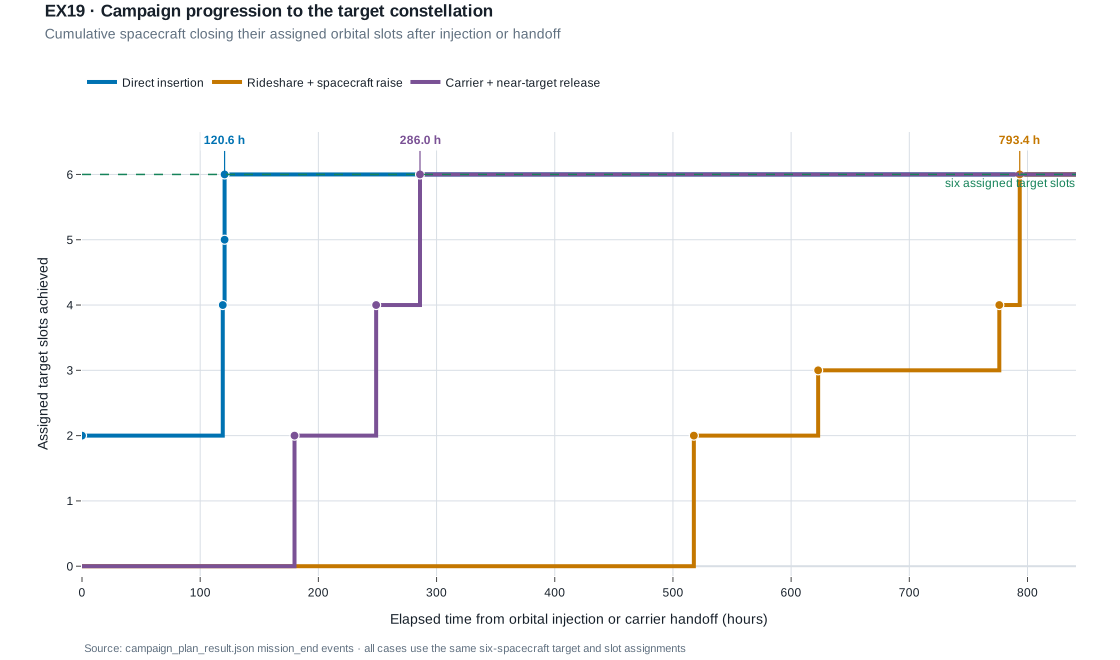
The step chart is calculated from the campaign mission_end event stream: each
rise means another spacecraft has closed its assigned orbital slot. These are
the same saved campaign and mission results inspected by the Streamlit campaign
viewer, presented together here to make the strategy comparison visible.
The carrier evidence also reports its delivery-envelope margins separately from the client-spacecraft burden:
| Carrier evidence, per plane | Result |
|---|---|
| Assigned payload | 270 kg of 300 kg |
| Required transfer delta-v | 78.0 m/s of 550 m/s |
| Hohmann transfer duration | 47.0 min |
| Checkout duration | 12.0 h |
| Release cadence | 30 min |
The carrier evidence is a performance-envelope check: it reports required transfer delta-v and capacity margin, while the spacecraft totals remain directly comparable across all three cases.
Artifacts To Inspect
| Artifact or result section | What it shows |
|---|---|
campaign_plan_result.json |
The complete request snapshot, outcome, assignments, events, and summaries |
campaign_summary.target_summary |
Six achieved positions and any residual target constraints |
campaign_summary.mission_burden_summary |
Aggregate delta-v, propellant, mission duration, and mission outcomes |
assignments |
The fixed spacecraft-to-plane and spacecraft-to-slot mapping |
events |
Transfer, carrier operations, release, maneuver, slot-acquisition, and completion sequence |
diagnostics → campaign_asset_delivery_summary |
Per-carrier payload, delta-v, timing, and envelope margins |
missions |
Per-spacecraft burden summaries; rerun with --mission-artifact-detail full for side bundles |
Generate a deterministic review for each result before asking an AI assistant to compare them:
astraeus review campaign \
  --result runs/campaign/deployment-comparison-dedicated/campaign_plan_result.json \
  --output runs/campaign/deployment-comparison-dedicated/review.md
Repeat the command for deployment-comparison-rideshare and
deployment-comparison-carrier.
AI-Assisted Trade Flow
The packaged campaign skills divide the work into explicit, reviewable steps:
- Use
$astraeus-campaign-composerto copy a case and change one delivery assumption while preserving the target, spacecraft, assignments, and policy. - Use
$astraeus-campaign-runnerto validate and execute each campaign. - Use
$astraeus-campaign-analyzeron each saved result, then ask the assistant to compare target achievement, spacecraft delta-v, propellant, readiness, assignments, and event sequence with citations to those artifacts.
This workflow leaves the engineering evidence in deterministic files. The AI assistant helps author variants and interpret the trade without becoming the source of the calculated result.
Interpretation
The 400 km rideshare case places the largest burden on the deployed spacecraft: its fleet delta-v is about 5.7 times the direct-insertion case. The carrier buys back most of that spacecraft burden by performing the first 140 km of the raise, but direct insertion remains the lowest-burden result for this target.
Readiness does not follow delivery altitude alone. The carrier completes its transfer and checkout in under 13 hours, yet the selected release phase and cadence leave some spacecraft with longer slot-acquisition arcs than direct insertion. The lower rideshare release orbit produces the longest campaign at about 33 days. The result shows why delivery orbit, release timing, phasing policy, and client-spacecraft burden belong in one trade rather than being assessed independently.