Native Earth-Fixed-Cell Grids
Astraeus can represent service demand on a latitude/longitude grid or on native Earth-fixed cells (EFCs). EFC mode is useful when the service denominator and beam-target identity should be a stable, beam-scale terrestrial cell rather than a coarse angular bin.
Cells are created before scheduling. The same identity is retained through population, targeting, scheduling, delivery, and reporting artifacts; EFC metrics are therefore tied to the cells actually evaluated by the run.
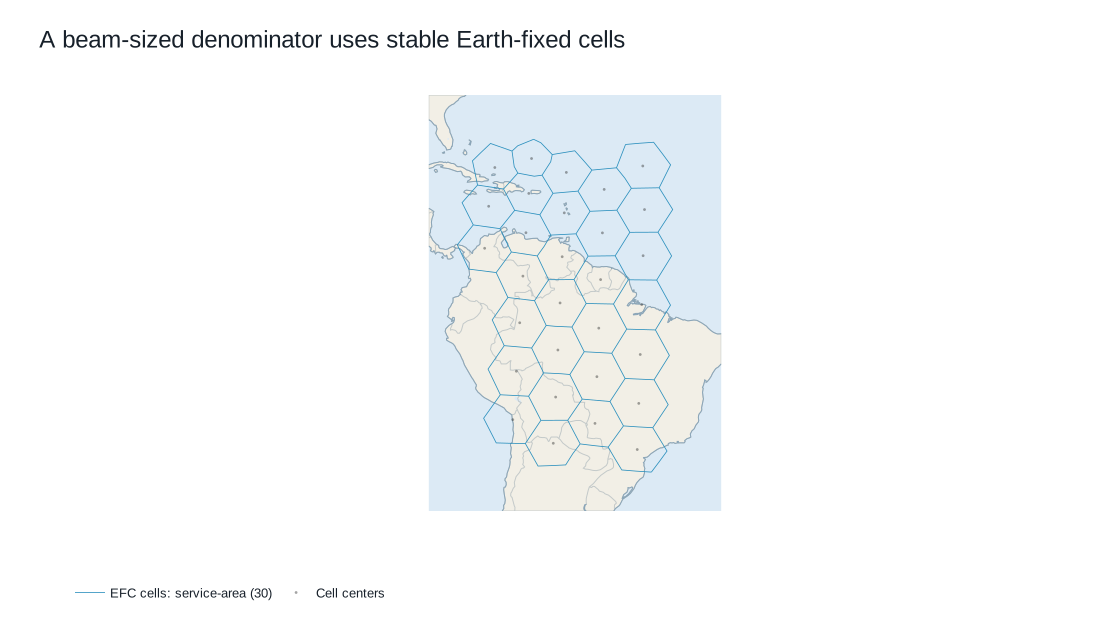
Native H3 cells provide stable Earth-fixed footprints and centers over the selected service region.
Choose The Denominator Deliberately
Use EFC mode for questions such as:
- how many beam-scale cells were eligible, feasible, targeted, or served?
- how broadly did beam targeting rotate through a service region?
- how does the result compare with an external Earth-fixed beam-cell model?
- how sensitive is service to cell size or boundary treatment?
Use a latitude/longitude grid for broad geographic coverage, coarse regional reporting, or continuity with an existing angular-grid study.
EFC-cell, latitude/longitude-cell, area-weighted, and demand-weighted percentages have different denominators. Compare percentages as equivalent physical claims only when grids, weights, demand, and normalization are aligned.
Configuration
Select EFC mode under the service population grid:
mission:
  kind: service
  service:
    population:
      grid:
        kind: efc
        provider: h3
        diameter_km: 500
        evaluation:
          mode: sampled
diameter_km is required. For H3, Astraeus selects the resolution whose average
cell diameter is closest to the request and records both the requested and
resolved sizing metadata.
Providers
| Provider | Use |
|---|---|
h3 |
preferred discrete global hexagonal grid for regional, wide-area, and global studies |
hex |
direct longitude/latitude hex-like lattice for compact fixtures or local sensitivities |
beam_footprint |
longitude/latitude lattice parameterized by a beam-footprint diameter |
external |
reserved configuration value for a future supplied-cell catalog path |
hex and beam_footprint use longitude/latitude construction whose physical
geometry varies with latitude. Use H3 for the normal global representation.
Boundary Evaluation
| Mode | Behavior |
|---|---|
centroid |
includes a cell when its center lies in the eligible area; fastest and least detailed at boundaries |
sampled |
evaluates a compact set of footprint samples; default balance for most studies |
exact_polygon |
evaluates polygon overlap; best boundary fidelity with higher geometry cost |
Use H3 with sampled evaluation for a normal engineering baseline. Use exact polygon evaluation when boundary inclusion materially affects the conclusion.
Stable Cell Identity
Native cells use stable PEFC service-point identifiers. H3 identifiers include
the selected resolution and underlying H3 cell reference. Key fields include:
| Field | Meaning |
|---|---|
cell_id |
native service-cell identifier |
target_cell_id |
cell considered or selected by beam targeting |
matched_area_id |
matching service region |
lat_deg, lon_deg |
representative cell center |
area_km2 |
cell area available to reporting and weighting |
That identity allows a result to distinguish the cell existing, being eligible, appearing in a target plan, passing feasibility, receiving an assignment, and receiving delivered traffic.
Artifacts
Mission-side EFC artifacts include:
| Artifact | Contents |
|---|---|
mission/service_population_summary.json |
denominator, provider, diameter, selected H3 sizing, evaluation mode, and counts |
mission/service_population_cells.* |
one row per native service cell |
mission/service_population_cell_footprints.* |
footprint vertices for maps and spatial review |
mission/service_population_beam_target_assignments.* |
target/feasibility/application rows keyed by EFC cell |
mission/service_population_beam_target_assignments_summary.json |
eligible, feasible, targeted, and applied cell counts |
When beam targeting is active, transport also writes:
| Artifact | Contents |
|---|---|
transport/beam_targeting_summary.json |
mode, objective, windows, selection concentration, and warnings |
transport/beam_target_plan.* |
resolved target windows by satellite and beam |
transport/beam_target_scheduler_rollup.* |
scheduler selections and rejections by target cell |
transport/beam_target_link_outcome_rollup.* |
feasibility, application, rejection, and steering-angle outcomes |
Metric Interpretation
Report the denominator beside every percentage. A useful minimum set is:
- eligible native-cell count;
- targeted, feasible, and applied cell counts;
- delivered traffic or served-demand KPI;
- area- or demand-weighting method where used;
- provider, resolved cell size, and boundary-evaluation mode.
selected_cell_fraction and selection_concentration describe scheduler
behavior. Read them alongside demand-served and data-delivery KPIs. A run
can deliver most requested traffic to concentrated demand while touching only a
small fraction of all eligible cells.
Beam targeting states also remain distinct:
| State | Meaning |
|---|---|
| Targeted | cell appears in a generated target plan |
| Feasible | at least one candidate passed the relevant physical checks |
| Applied | beam used the cell as an active target |
| Rejected | cell was considered but not applied, with a reason where available |
Long dwell, sparse demand, strict priorities, or hotspot objectives may intentionally concentrate selections. Coverage-rotation objectives broaden the target set but remain bounded by visibility, link closure, steering, beam count, and dwell policy.
Packaged Example
The beam-hopping example uses a native H3 grid over Europe and West Africa:
astraeus run astraeus-resources/examples/user/beam-hopping-capacity.yaml
Start with a dry run after changing service area or diameter. A smaller diameter can sharply increase cell count, candidate work, and retained artifact volume.
Scale And Fidelity Limits
- Runtime and memory grow with eligible cells, visible candidates, target windows, satellites, beams, and requested artifact detail.
- EFC mode supplies geography and stable identity; interference, beam hopping, forecasting, handover, and optimization require their own explicit model configuration.
exact_polygonhas higher geometry cost than sampled or centroid evaluation.externalcell catalogs are reserved but not yet executable.- H3 cell area varies with location and resolution. Use emitted
area_km2for area-weighted summaries rather than assuming equal physical area.
See Protocol-Informed Beam Hopping for ordered allocation and continuity, and Geometry And Coverage for spatial aggregation modes.