EX07 — ISL-Routed Network
Tags: inter-satellite links · routing · gateway relay · store-and-forward
Input: isl-routed-network.yaml · Runtime tier: standard · Recommended views: 3D, Analysis
Purpose
Show how global user traffic reaches a single gateway over a sparse, Walker-adjacent inter-satellite-link topology.
Setup
The network contains 72 satellites in six planes, one Madrid gateway, an eight-hour time window, and a 15° global demand grid.
astraeus run astraeus-resources/examples/user/isl-routed-network.yaml
RunSpec Focus
The key change from a direct service case is isl_gateway_routed path selection
with bounded range and hop count.
transport:
  scheduler:
    path_mode: isl_gateway_routed
    gateway_selection: lowest_latency_visible
  isl:
    enabled: true
    topology: walker_adjacent
    max_range_km: 8000
    max_hops: 8
    capacity_mbps: 300
Results
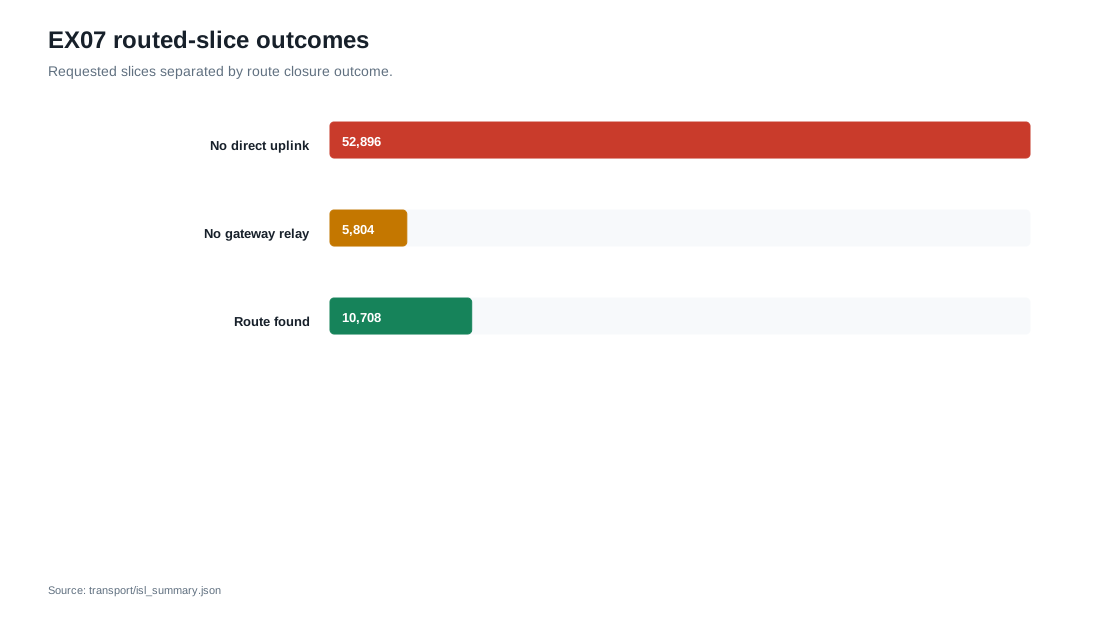
The reference run completed successfully in 58.44 seconds. Routes were found for 10,708 of 69,408 requested slices (15.43%). The selected routes averaged 3.00 hops and reached a maximum of six. Traffic delivery was 8.570 GB of 15.617 GB (54.88%); the large latency values include scheduling, queueing, and relay waiting alongside link transit.
Artifacts To Inspect
| Artifact | What it shows |
|---|---|
transport/isl_summary.json |
Topology pruning, route closure, hop count, and routing diagnostics |
transport/isl_routes.parquet |
Selected paths, waits, hop counts, latency components, and denial reasons |
transport/transport_summary.json |
Traffic admission, delivery, backlog, and scheduler outcomes |
transport/kpi_summary_gateways.parquet |
Traffic and loading at the single destination gateway |
Interpretation
ISLs turn some otherwise isolated user opportunities into gateway-reachable paths, but one gateway remains a strong availability constraint. Separate hop count and link latency from queueing and store-forward waiting when interpreting end-to-end latency.