Sweeps
A sweep expands one base runspec_v8 input into related parameter variants. Use
it when the engineering question is comparative and every case should share the
same model structure.
Use a batch instead when the cases are independently authored RunSpecs.
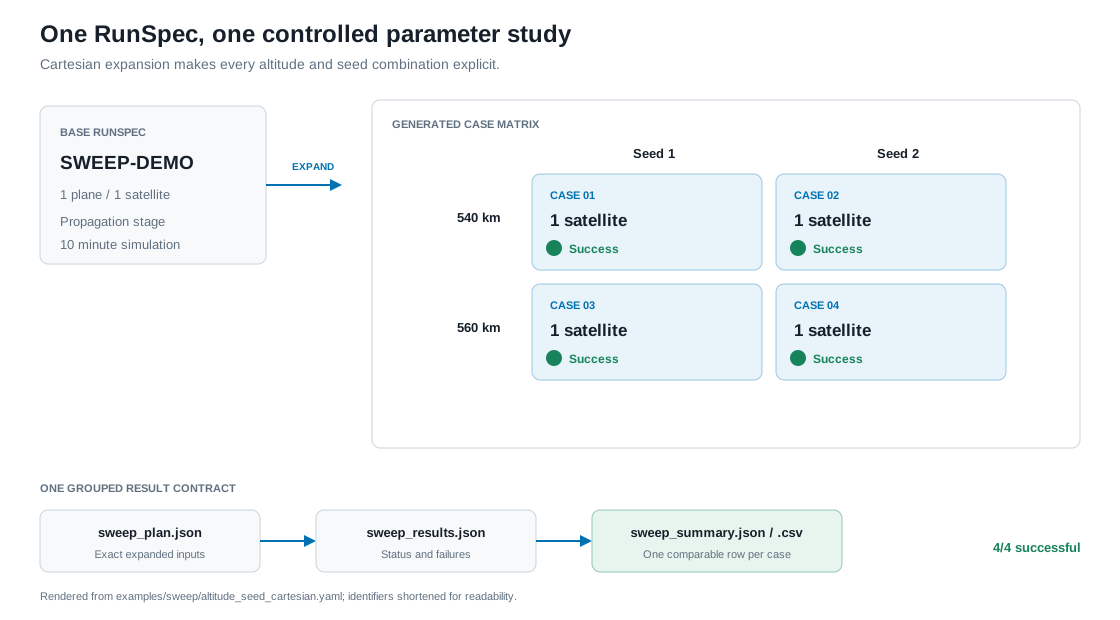
Define The Variants
The top-level sweep block supports:
cartesian: the product of ordered value listscases: an explicit sparse list of override patches
sweep:
  mode: cartesian
  dimensions:
    - path: constellation.design.orbit.altitude_km
      values: [500, 550, 600]
    - path: runtime.seed
      values: [11, 22]
  summary:
    fields:
      - coverage.union_coverage_fraction
    write_csv: true
Override paths address fields in the base RunSpec. Review the fully expanded plan
before executing a large matrix. astraeus run rejects an active sweep block so
that a multi-case input cannot accidentally run as one case.
Plan, Then Run
The curated altitude study is a useful baseline:
astraeus sweep plan astraeus-resources/examples/user/altitude-trade-sweep.yaml
Planning validates every expansion, materializes canonical child RunSpecs, and
prints the path to sweep_plan.json without executing cases.
Execute it with bounded local workers:
astraeus sweep run astraeus-resources/examples/user/altitude-trade-sweep.yaml --workers 2
Serial execution is the default. Increase --workers only after considering the
per-case memory footprint; workers run isolated child processes.
Useful planning and execution options are:
| Option | Purpose |
|---|---|
--sweep-id <id> |
Choose the grouped bundle name. |
--output-root <path> |
Change the default runs/sweeps root. |
--profile-root <path> |
Resolve imported profiles from a stable root. |
--max-cases <n> |
Record and print a soft warning above the chosen case count. |
--workers <n> |
Set bounded local concurrency. |
--write-summary-csv |
Add a tabular export beside the JSON summary. |
--max-cases sets a warning threshold; execution may continue above it.
Results And Exit Behavior
The grouped bundle contains:
runs/sweeps/<sweep_id>/
|-- base_runspec.json
|-- sweep_plan.json
|-- sweep_attempts.json
|-- sweep_results.json
|-- sweep_summary.json
|-- sweep_summary.csv
`-- cases/<case_id>/
    |-- runspec.json
    `-- attempts/<attempt_id>/
        `-- <standard run artifacts>
The CSV is optional; the JSON summary is the contract. Read the plan first, then current results, attempt history, comparison summary, and only then individual child bundles.
Successful child attempts are preserved when a sibling fails. Mixed outcomes
produce grouped artifacts with partial_success and command exit code 4;
exit code 0 means every current case succeeded.
Resume And Rerun
Recovery operates on the existing grouped bundle, not the original RunSpec:
astraeus sweep resume runs/sweeps/<sweep_id>
astraeus sweep resume runs/sweeps/<sweep_id> --retry-failed
astraeus sweep rerun runs/sweeps/<sweep_id> --failed
astraeus sweep rerun runs/sweeps/<sweep_id> --case <case_id>
astraeus sweep rerun runs/sweeps/<sweep_id> --all
resume selects incomplete current cases. --retry-failed includes failed
cases. rerun deliberately creates a new attempt for the selected failed,
named, or complete case set. --workers is available on recovery commands too.
Always compare the current/latest result view with attempt history when a case has been rerun.
See Understanding outputs for the common child-run contract.