EX14 — Propulsion-Power Coupling
Tags: finite burns · electric propulsion · propellant · power
Input: propulsion-power-coupling.yaml · Runtime tier: standard · Recommended views: Power, Analysis
Purpose
Show how commanded electric-propulsion burns change orbit state, consume propellant, and create time-varying electrical load on the same spacecraft.
Setup
One satellite executes two prograde burns over a six-hour window. A 0.5 N, 1,500 s-Isp engine is coupled to a 1,000 Wh battery and body-mounted arrays.
astraeus run astraeus-resources/examples/user/propulsion-power-coupling.yaml
RunSpec Focus
The finite-burn plan names the engine, start time, duration, throttle, and orbital direction. The power block maps that engine to standby and throttle-scaled load.
propulsion:
  maneuver_plans:
  - finite_burns:
    - burn_id: orbit-trim
      duration_s: 600
      engine_id: ep-main
      throttle: 0.75
      direction: {mode: orbital_enum, orbital_enum: prograde}
power:
  propulsion:
    ep-main:
      active_increment_w_at_full_throttle: 600
      scaling: linear
Results
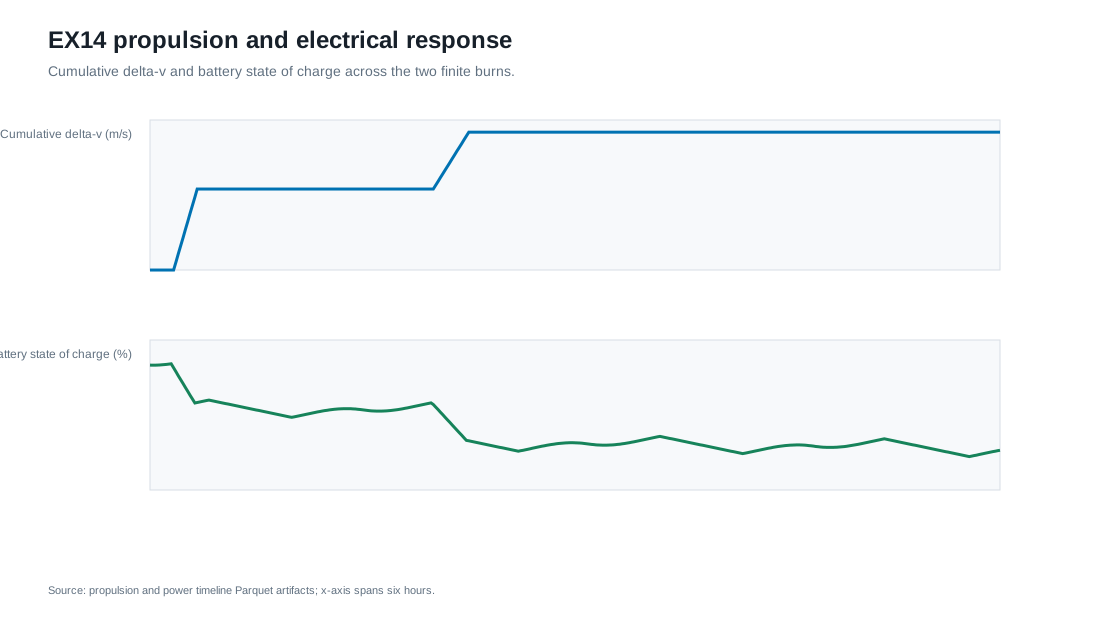
The reference run completed successfully in 0.39 seconds. The burns produced 1.561 m/s fleet delta-v and consumed 26.00 g of propellant. Peak propulsion load was 462 W; state of charge ranged from 61.68% to 80.24%, with no energy-deficit samples or power infeasibility.
Artifacts To Inspect
| Artifact | What it shows |
|---|---|
propulsion/propulsion_summary.json |
Final delta-v, propellant, target evaluation, and fleet rollups |
propulsion/burn_events.parquet |
Requested and realized timing, throttle, direction, and burn outcome |
propulsion/timeline_propulsion.parquet |
State vector, active burn, mass, and cumulative delta-v by sample |
power/timeline_power.parquet |
Thruster electrical load, generation, net power, and battery response |
Interpretation
The case connects maneuver authority to two consumables: propellant and stored energy. Its negative median orbital energy margin indicates net battery draw during this finite window even though the battery remains feasible; longer or repeated campaigns require a wider recharge-horizon study.