EX08 — Beam-Hopping Capacity
Tags: beam hopping · Earth-fixed cells · interference · fairness
Input: beam-hopping-capacity.yaml · Runtime tier: extended · Recommended views: 2D, Analysis
Purpose
Evaluate how a continuity-aware beam-hopping scheduler allocates four beams among competing demand cells while respecting co-channel conflicts.
Setup
Twenty-four satellites serve Europe and West Africa through Madrid and Dakar. Demand is represented by sampled Earth-fixed cells and scheduled in 20 ms slots over a two-hour geometry timeline.
astraeus run astraeus-resources/examples/user/beam-hopping-capacity.yaml
RunSpec Focus
The distinctive block combines continuity, admission, surplus allocation, and an EFC conflict graph.
transport:
  scheduler:
    max_active_beams_per_sat_per_step: 4
    beam_hopping:
      enabled: true
      policy: continuity_backlog
      slot_duration_s: 0.02
      continuity:
        profile_id: nr_full_illumination_reference_v1
      cochannel:
        mode: efc_conflict_graph
        adjacency_rings: 1
Results
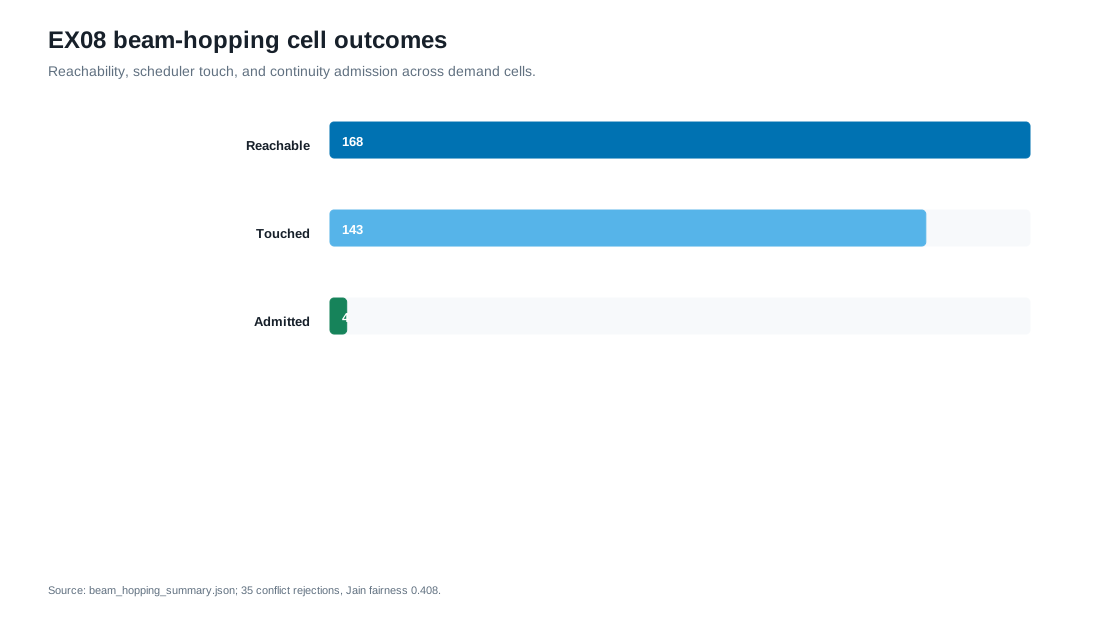
The reference run completed successfully in 13.78 seconds. Four cells were admitted, 168 became reachable, and 35 candidate allocations were rejected for conflicts. The scheduler delivered 840.45 MB and recorded no continuity deadline misses or cycle-jitter violations. Delivered-byte Jain fairness was 0.408.
Artifacts To Inspect
| Artifact | What it shows |
|---|---|
transport/beam_hopping_summary.json |
Admission, conflicts, continuity, fairness, backlog, and workload diagnostics |
transport/beam_hopping_assignment_runs.parquet |
Retained beam-to-cell assignments across slot runs |
transport/kpi_scheduler_by_point.parquet |
Offered and served traffic resolved by demand cell |
transport/transport_backlog_timeline.parquet |
Accumulated demand and backlog age across the study |
Interpretation
The result demonstrates a feasible continuity schedule, while the low fairness value shows that delivered capacity is unevenly distributed under the configured priority and geometry. Admission count, conflict rejections, continuity checks, and fairness should be reviewed together rather than reducing the study to throughput alone.