Power
The power stage combines solar generation, spacecraft loads, and battery energy on the simulation timeline. Use it to answer:
- how does state of charge evolve?
- when do generation or storage margins close?
- how do attitude, service activity, or propulsion change the load?
- which array or battery variant closes the same scenario?
Generation And Storage
Panels may be body-mounted, fixed deployed, or single-axis steerable. Generation uses solar irradiance, panel area and efficiency, conversion efficiency, eclipse state, and incidence angle. Steerable panels apply angle and slew-rate limits, so the commanded and achieved panel angles can differ. A solar-array drive assembly (SADA) is the modeled single-axis steering mechanism; its angle is the commanded or applied rotation about that drive axis.
Battery energy is integrated step by step from net power. The model reports state of charge together with low-SOC, high-SOC, and power-deficit conditions.
power:
  panels:
    - kind: body_mounted
      panel_id: positive-x
      area_m2: 0.3
      efficiency: 0.31
      normal_body: [1.0, 0.0, 0.0]
  battery:
    capacity_wh: 1000
    soc_init_pct: 80
    soc_min_pct: 20
    soc_max_pct: 98
  subsystems:
    - name: spacecraft-bus
      role: bus
      draw_w: 28
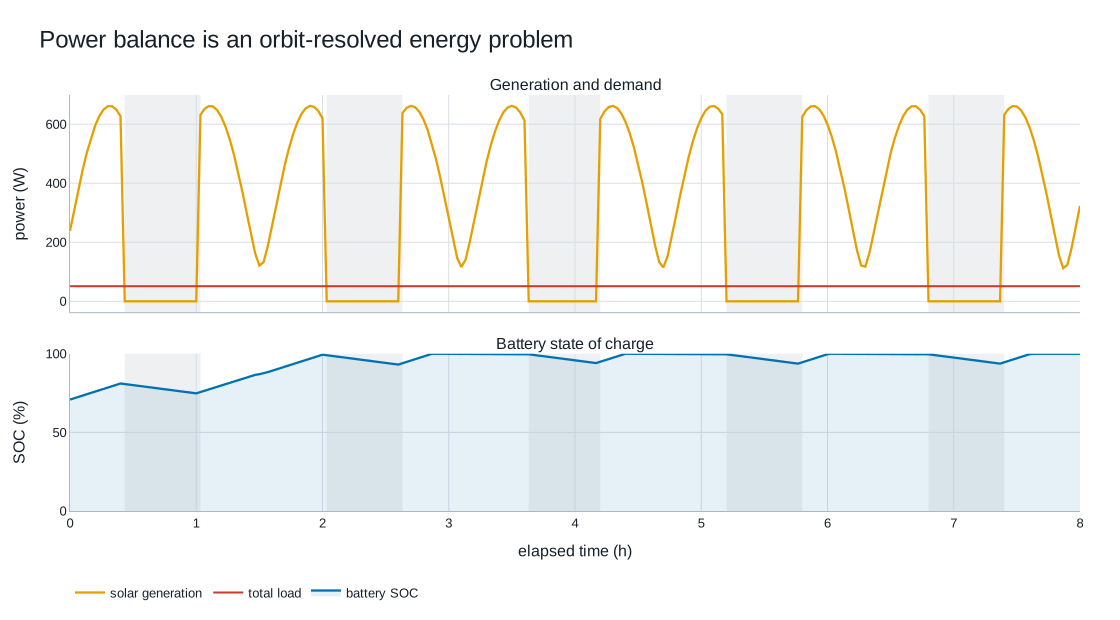
The shared timeline makes eclipse, generation, load, and state-of-charge changes directly comparable.
Load Model
The total load is additive. Depending on the RunSpec it can include:
| Load family | Source |
|---|---|
| Spacecraft bus | fixed subsystem draws and attitude mode-state increments |
| Payload | fixed standby/base draw or activity-driven operational draw |
| Feeder and ISL equipment | manual standby/RX/TX increments or RF-derived equipment assumptions |
| Observation activity | capture and processing activity counts |
| Propulsion | standby and throttle-weighted finite-burn electrical load |
The assembled load is adjusted by the configured load efficiency before battery integration.
Fixed And Activity-Driven Payloads
Use a fixed payload when its draw should not depend on service execution:
power:
  payload:
    policy:
      mode: fixed_only
    loads:
      fixed_w: 24
Use hybrid when payload power should follow the reduced activity profile
created by a service/transport run. Its required driver represents the
conservative scheduled requirement; served follows realized execution. Hybrid
power therefore requires the upstream service and transport context that
creates those activity channels.
Finite-slew attitude availability is applied to panel orientation and, by default, to communications and payload activity. This keeps generation and load consistent during acquisition and settling.
Payload resource scheduling uses the RF-derived hybrid load contract to enforce a service-payload DC ceiling before committing allocations. That ceiling is separate from spacecraft bus and battery limits.
Power Sizing
power.sizing compares power-domain variants while reusing one fixed upstream
scenario. It avoids rerunning propagation, attitude, service, transport, and
activity reduction for every array or battery case.
power:
  sizing:
    enabled: true
    variants:
      - id: larger-array
        overrides:
          power:
            panel_area_m2: 0.5
      - id: larger-battery
        overrides:
          power:
            battery:
              capacity_wh: 900
Use sizing variants for power configuration such as panel area or efficiency, battery limits, subsystem and payload loads, and equipment assumptions. Use a normal sweep when the variant changes scenario truth such as orbit, constellation, geography, demand, scheduling, gateway configuration, or attitude mode family.
Outputs
| Artifact | Contents |
|---|---|
power/timeline_power.parquet |
generation, load components, net power, battery energy, SOC, and eclipse state |
power/power_summary.json |
energy balance, margins, extrema, and violation counts |
power/power_violations.* |
timestamped power and SOC violations |
power/power_panel_angles.* |
commanded and applied panel angles |
power/power_profiles.json |
resolved per-satellite generation, storage, and load assumptions |
power/rf_derived_equipment.json |
resolved RF source and DC-load assumptions when RF-derived equipment is used |
power/sizing/ |
status, summaries, profiles, and optional timelines for each sizing variant |
The Console power and analysis views read these saved artifacts.
Packaged Examples
| Question | Example |
|---|---|
| Does a 24-satellite service timeline sustain its power balance? | astraeus-resources/examples/user/spacecraft-power-balance.yaml |
| Which array and battery variants close a fixed case? | astraeus-resources/examples/user/power-sizing.yaml |
| How do panel mounting and tracking affect the same spacecraft power balance? | astraeus-resources/examples/user/power-array-architecture-trade.yaml |
| What is the electrical effect of two finite EP burns? | astraeus-resources/examples/user/propulsion-power-coupling.yaml |
| How do observation, transport, activity, and power behave together? | astraeus-resources/examples/user/observation-to-delivery.yaml |
| How does active-beam load change the energy margin of an otherwise fixed service architecture? | astraeus-resources/examples/user/studies/integrated-service-power-trade.yaml |
Interpretation Limits
- Eclipse uses a cylindrical-shadow approximation rather than a penumbra model.
- The battery is a lumped deterministic energy store. Thermal behavior, degradation, cell balancing, and detailed charge-control dynamics require a higher-fidelity battery model.
- Load resolution is an additive spacecraft-level power balance across declared base, activity, payload, and propulsion consumers.
- Results depend on intentional attitude and activity configuration; static defaults may hide operational power peaks.
- Cadence limits the timing resolution of short activity and violation events.
For exact fields and sizing restrictions, see the RunSpec reference.