Protocol-Informed Beam Hopping
Maturity: Preview
Beam hopping time-shares a finite set of physical payload beams across a larger set of Earth-fixed service cells. Use it when cell illumination timing, switching loss, continuity admission, reuse, or interference materially changes the service result.
It is more specific than normal beam targeting. Targeting decides where a beam is directed during a geometry window; beam hopping builds an ordered sub-second assignment schedule inside that window and carries continuity and queue state forward.
Two Time Scales
- The simulation step updates orbit geometry, path availability, steering feasibility, and clear-link closure.
- The hopping slot and planning horizon represent the ordered beam-to-cell schedule while that geometry sample remains valid.
The planned superframe repeats across the geometry interval. Switching guard time reduces useful capacity, and admission, queue, prior-target, and continuity state carry across geometry samples. For exact repetition, use a simulation step that is an integer multiple of the planning horizon.
Each assignment must pass the complete configured chain: reachable transport path, payload-beam steering, conservative service-link closure, beam concurrency, and the selected co-channel policy. Scheduled capacity then feeds normal transport delivery, backlog, and payload-activity accounting.
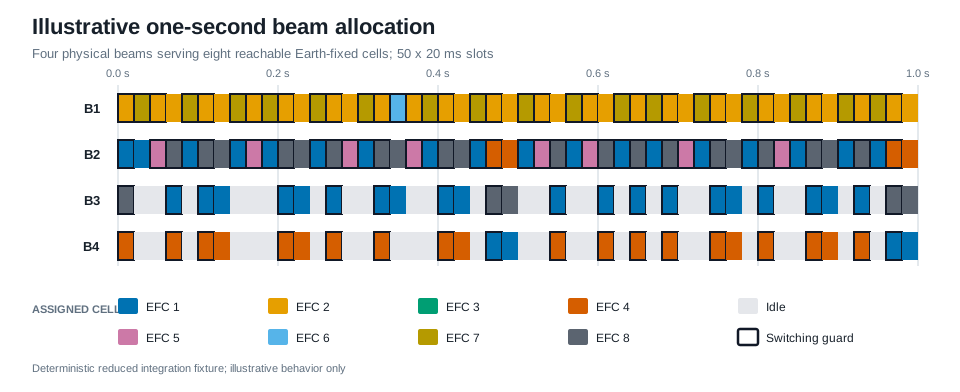
Color identifies the assigned Earth-fixed cell, gray is idle, and a dark outline marks switching guard. One reachable cell receives no slot, illustrating the separate reachability and allocation gates.
Configuration
Beam hopping is disabled by default. Enable it under the scheduler:
transport:
  scheduler:
    path_mode: direct_plus_gateway
    scheduler_mode: greedy_capacity
    default_offered_load_bps: 100000
    max_active_beams_per_sat_per_step: 4
    beam_hopping:
      enabled: true
      policy: continuity_backlog
      slot_duration_s: 0.02
      planning_horizon_s: 1.0
      switching:
        fixed_guard_s: 0.001
      continuity:
        illumination_semantic: full_illumination
        profile_id: nr_full_illumination_reference_v1
      admission:
        objective: priority_continuity
        lookahead_horizon_s: 2.0
        min_commitment_s: 2.0
        hysteresis: 0.1
      surplus:
        policy: weighted_deficit
      cochannel:
        mode: efc_conflict_graph
        adjacency_rings: 1
The current mode expects a native H3 Earth-fixed-cell grid, one transport point
per cell, normal link closure, a geometry step at least as long as the planning
horizon, and the full_illumination continuity semantic.
Continuity And Admission
A continuity profile resolves to four engineering primitives:
| Primitive | Meaning |
|---|---|
max_dark_time_s |
longest modeled gap between qualifying illuminations |
min_illumination_s |
minimum useful contiguous illumination |
min_duty_cycle |
minimum useful beam-time fraction over the horizon |
max_cycle_jitter_s |
maximum permitted variation in consecutive service-cycle periods |
These profiles expose their source and resolved values in the artifacts as explicit system-study assumptions.
Rolling admission preserves feasible commitments before expanding the admitted set. Objectives include:
coverage_maxfor deterministic cell-count breadth;demand_weightedfor higher offered load;priority_continuityfor existing commitments followed by demand-weighted expansion.
After continuity reservations, weighted_deficit distributes surplus while
limiting persistent under-service. max_weight_throughput provides a
throughput-oriented sensitivity.
Co-Channel Fidelity
| Mode | Interpretation |
|---|---|
none |
ideal upper bound with no co-channel restriction |
efc_conflict_graph |
fast binary reuse policy based on cell adjacency and optional distance |
active_set_sinr |
quantitative mutual-interference closure for each simultaneously active set |
active_set_sinr uses the resolved per-beam transmit power and beam pattern.
Weak potential interferers may be omitted only within the configured
max_omitted_interference_penalty_db bound. hard_conflict_precheck: true
requires both the binary reuse rule and SINR closure.
When a candidate fails, the scheduler can make one deterministic replacement of a lower-ranked, non-reserved assignment. The configured algorithm ends after that replacement; frequency and power remain fixed inputs.
For SINR runs, compare clear-link margin with scheduled active-set SINR margin. Their difference is the modeled co-channel penalty; a scheduled assignment must retain non-negative required-direction SINR margin.
Interpret The States Separately
| State | Meaning |
|---|---|
| Reachable | at least one physical beam/cell candidate closed |
| Touched | at least one useful hopping assignment was made |
| Admitted | rolling policy accepted the cell for continuity service |
| Continuity compliant | modeled dark-time, illumination, duty, and jitter limits were met |
| Delivered | scheduled capacity transferred queued service bytes |
A reachable cell may be unadmitted when the requested continuity envelope does
not fit. An admitted cell may remain demand-limited when the reserved service is
feasible but the requested traffic exceeds surplus capacity. Treat zero guard
time and cochannel.mode: none as ideal sensitivity bounds; use configured
operational assumptions for decision results.
Outputs
Enabled runs write under transport/:
| Artifact | Contents |
|---|---|
beam_hopping_summary.json |
configuration, provenance, counts, losses, fairness, and performance diagnostics |
beam_hopping_by_cell.* |
reachability, admission, continuity, duty, delivery, and backlog by cell |
beam_hopping_by_beam.* |
utilization, target changes, guard, useful, and idle time by physical beam |
beam_hopping_assignment_runs.* |
lossless run-length-encoded assignments |
beam_hopping_detailed_slots.* |
explicit slot truth for bounded full_debug runs |
beam_hopping_interference_by_cell.* |
clear/SINR margin and interference rollups for SINR mode |
beam_hopping_interference_by_beam.* |
interference outcomes by physical beam |
beam_hopping_interference_decisions.* |
bounded rejection/replacement evidence for SINR debug runs |
artifacts.detail: summary keeps aggregate service and performance evidence
without campaign-length assignment tables. standard retains compressed
assignment evidence. Use full_debug only after reviewing its projected slot
row count.
Packaged Example
Run:
astraeus run astraeus-resources/examples/user/beam-hopping-capacity.yaml
The example schedules four steerable beams across native H3 cells in two regions for two hours. It includes switching guard, continuity admission, weighted-deficit surplus, and a binary one-ring co-channel conflict policy.
Scale And Fidelity Limits
- Exact admission cost grows with horizon-active cells, physical beams, slots, and allocation attempts. When a whole-set feasibility certificate fails, deterministic incremental admission is more expensive.
- Large studies should normally use summary artifacts and preflight after changing cell diameter, service area, beam count, slot duration, or horizon. Unsafe dimensions fail with corrective guidance.
- Model resolution covers protocol-informed beam timing, continuity, admission, allocation, downlink co-channel effects, and delivery. Uplink mutual interference, persistent control illumination, joint channel/power allocation, multi-swap scheduling, and angle-dependent switching time remain outside the calculation.
- Candidate closure uses a conservative duplex gate, including for one-way service studies.
See Native Earth-Fixed-Cell Grids for the service denominator and Communications, Service, And Transport for the surrounding link, scheduler, and delivery model.