Attitude
The attitude stage turns a propagated trajectory and pointing policy into a spacecraft-orientation timeline. Use it to answer:
- which pointing mode was active?
- where were the body axes directed?
- how much usable time was lost to slew and settling?
- what panel or payload orientation should downstream models use?
Pointing Modes
| Mode | Behavior |
|---|---|
nadir |
Points body +Z toward Earth center. |
sun_pointing |
Aligns a selected body vector with the analytic Sun direction. |
fixed |
Uses an explicit request quaternion. |
nadir_sun |
Maintains nadir pointing and uses the in-plane Sun projection to select yaw. |
sat_track |
Tracks another satellite while the configured contact conditions are met. |
nadir_isl |
Maintains nadir while steering an in-plane axis toward another satellite. |
adcs.default_mode provides the baseline. attitude_mode_set, schedule policy,
and mission behavior can create mode changes over time. Tracking modes have
fallback behavior when their target or contact condition is unavailable.
adcs:
  default_mode: nadir_sun
  attitude_mode_set: sat_track_emphasis
  sat_track:
    contact_gate: geometry
    fallback_mode: nadir
    max_range_km: 2500
  sun_tracking_body_vector: [1.0, 0.0, 0.0]
  isl_tracking_body_vector: [1.0, 0.0, 0.0]
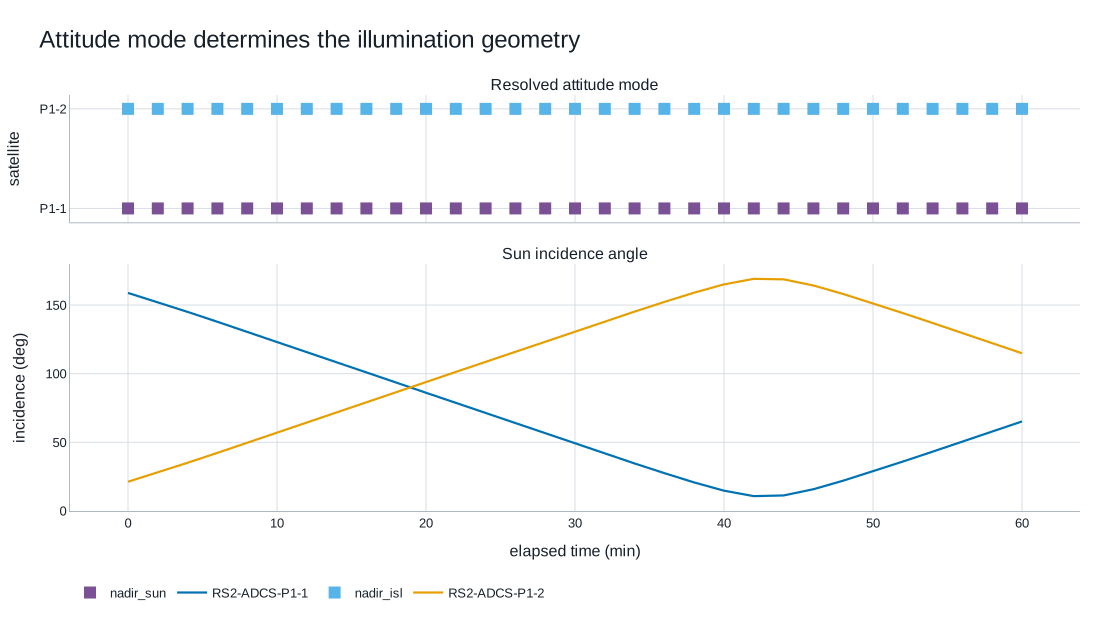
The resolved mode and Sun-incidence history share the simulation timeline, so
the geometric consequences of a pointing policy can be reviewed directly.
Sun incidence is the angle between the realized spacecraft body +Z axis and
the Sun direction.
Instantaneous And Finite-Slew Realization
The default instantaneous mode applies each commanded orientation without an
acquisition delay. Use slew_envelope when transition time should reduce
usable mission time:
imports:
  - profiles/spacecraft.yaml

adcs:
  default_mode: nadir_sun
  realization:
    mode: slew_envelope
    profile_id: customer_reaction_wheel
The mobility profile supplies maximum angular rate, maximum angular acceleration, settling time, and provenance. Astraeus follows the shortest quaternion path with a symmetric rate/acceleration envelope. It is a reduced-order acquisition model rather than a controller or rigid-body simulation.
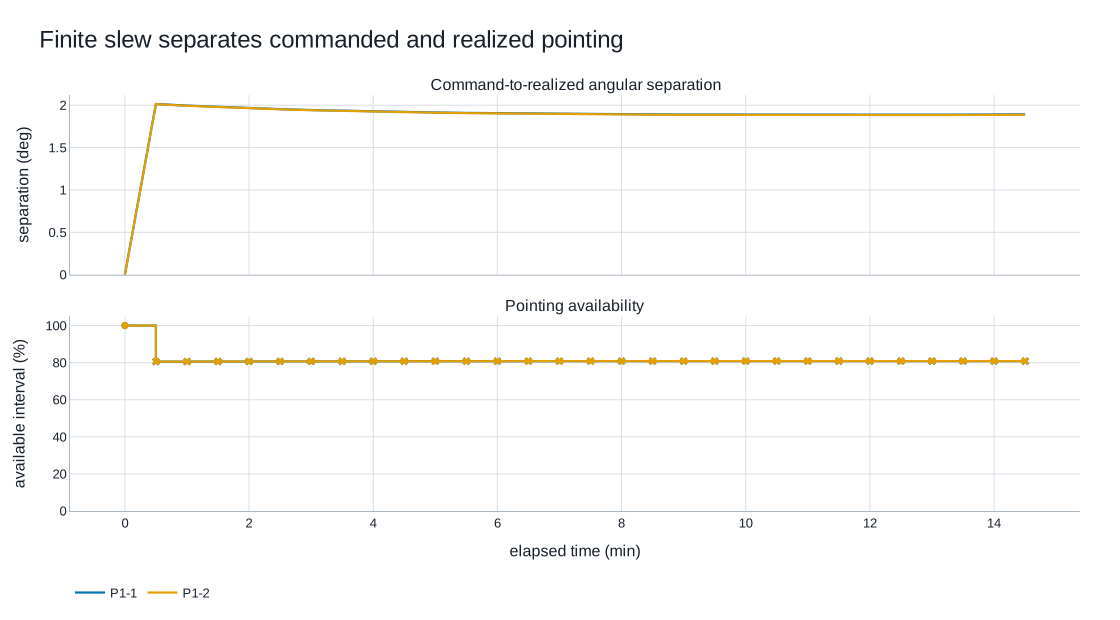
pointing_available_fraction preserves partial availability within each
simulation interval. By default, the realized orientation and available
fraction affect communications, observation/payload activity, and power.
Geometric line of sight itself is unchanged; the availability determines how
much of that geometry is operationally usable.
Consumer coupling can be disabled under adcs.realization.coupling for bounded
diagnostic comparisons. Such an opt-out is a partial-fidelity case rather than
a normal physical operating mode.
Outputs
| Artifact | Contents |
|---|---|
attitude/timeline_attitude.parquet |
realized quaternion, body axes, mode, and Sun-incidence timeline |
attitude/attitude_summary.json |
dimensions, mode counts, realization settings, and availability summary |
attitude/attitude_modes.json |
stable mode-code definitions |
attitude/timeline_attitude_commanded.parquet |
commanded orientation for finite-slew runs |
attitude/timeline_attitude_realization.parquet |
slew/settling state and interval availability |
attitude/attitude_transitions.parquet |
transition timing, angle, and analytic/calibrated provenance |
The last three are emitted for finite-slew realization. The Console uses these artifacts for mode, incidence, transition, and pointing-availability views.
Packaged Example
Run:
astraeus run astraeus-resources/examples/user/finite-slew-attitude.yaml
This case follows six satellites and three regional observation targets for 12 hours with a 30-second cadence. It is intended to show the difference between requested and achievable pointing, not just a static attitude mode.
For an integrated observation, transport, activity, and power case, use
astraeus-resources/examples/user/observation-to-delivery.yaml.
Model Resolution
- The finite-slew model resolves commanded-to-realized pointing and calibrated transition timing. Rigid-body dynamics, control loops, actuator saturation, momentum management, disturbances, sensors, and estimation error require higher-fidelity models.
- Mobility calibration changes transition timing only inside its declared applicability; otherwise the analytic envelope is used.
- Pointing commands and availability share the simulation cadence. A coarse step can hide short transitions or reduce timing precision.
- Some attitude modes map to the same downstream power load bucket even though their geometric orientation remains different.
For exact fields, see the RunSpec reference.