Communications, Service, And Transport
Astraeus models the chain from geometric opportunity to delivered service. It can distinguish a satellite being visible from a link closing, a link closing from a scheduler admitting traffic, and admitted traffic from data reaching its destination.
Use this capability to study:
- user and gateway link closure, margin, capacity, and latency;
- spatial and time-varying service demand;
- fixed, generated, and dynamically targeted payload beams;
- resource-constrained scheduling and denial causes;
- direct, gateway, store-and-forward, and ISL-routed delivery;
- delivered traffic, backlog, regional KPIs, and observation-product delivery.
Separate The Questions
The result is easiest to interpret as a sequence of gates:
| Gate | Question | Typical evidence |
|---|---|---|
| Geometry | Is the endpoint visible and inside the configured field of regard? | access windows and candidate counts |
| RF closure | Does the selected terminal/profile meet its required margin? | link samples and margin rollups |
| Beam eligibility | Can an appropriate beam cover or steer to the endpoint? | beam assignments and targeting summary |
| Path availability | Does the selected direct, gateway, or ISL path exist? | path and route diagnostics |
| Admission | Were link, beam, flow, and throughput resources available? | scheduler assignments and denial reasons |
| Delivery | How much traffic or product data arrived, and when? | delivery events, latency, and backlog |
A coverage percentage represents only the geometry gate. Communications service results combine all configured gates and resource limits.
Profiles And Link Budgets
Reusable communications profiles define the link family and assumptions such as center frequency, bandwidth, bitrate, required C/N or E_b/N_0, implementation margin, and fixed processing or queue latency. Antenna surfaces define transmit power, receive G/T or noise assumptions, beam gain, roll-off, mounting, and steering limits.
At each candidate link Astraeus combines range-dependent propagation loss with the configured terminal, antenna, atmospheric/rain, and implementation assumptions. The resulting margin determines closure; declared bitrate and scheduler limits determine how much of a closing link can be used.
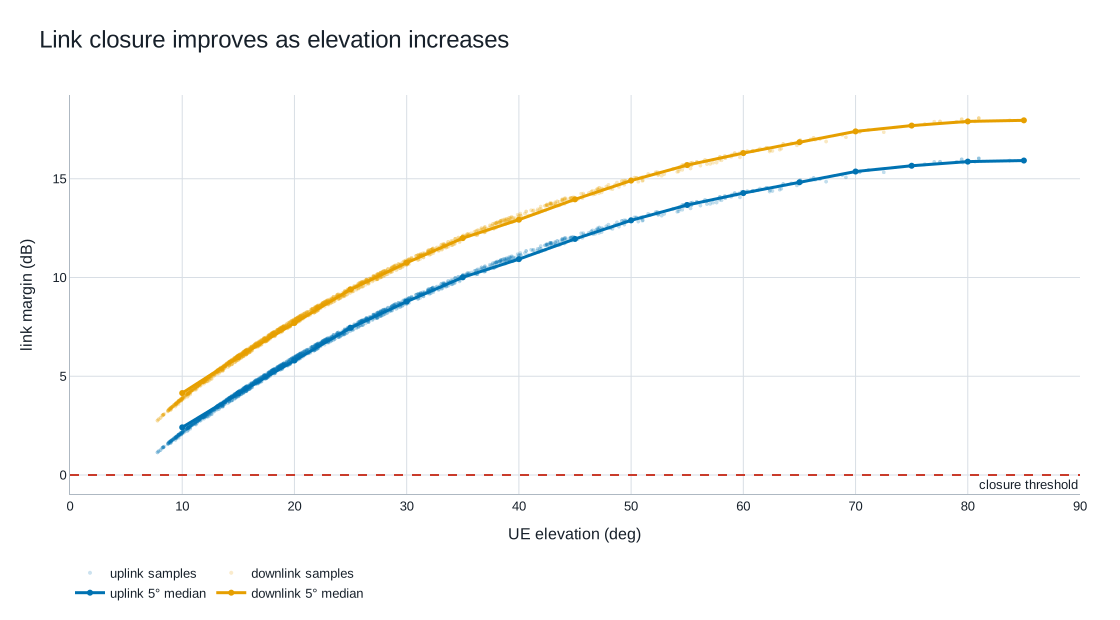
The zero-decibel threshold separates closing from non-closing samples. Margin usually improves with elevation, but the exact result remains profile- and environment-dependent.
Service Demand And Scheduling
A service mission defines user points or population-derived cells, terminal profiles, eligibility, and optional temporal demand. The transport scheduler then assigns those flows to closing paths under the configured resource limits.
mission:
  kind: service
  service:
    profile_id: customer_nr_service
    ue:
      min_elevation_deg: 5
      min_access_s: 45

transport:
  scheduler:
    path_mode: gateway_required
    scheduler_mode: greedy_capacity
    default_offered_load_bps: 12000
    max_uplink_bps_per_sat: 2000000
    max_feeder_bps_per_sat: 20000000
    max_parallel_ue_flows_per_sat: 16
Offered demand can be uniform, assigned per point, or generated from population cohorts and local-time curves. The scheduler can also constrain active beams, flows per beam, assignments per point, and per-satellite throughput.
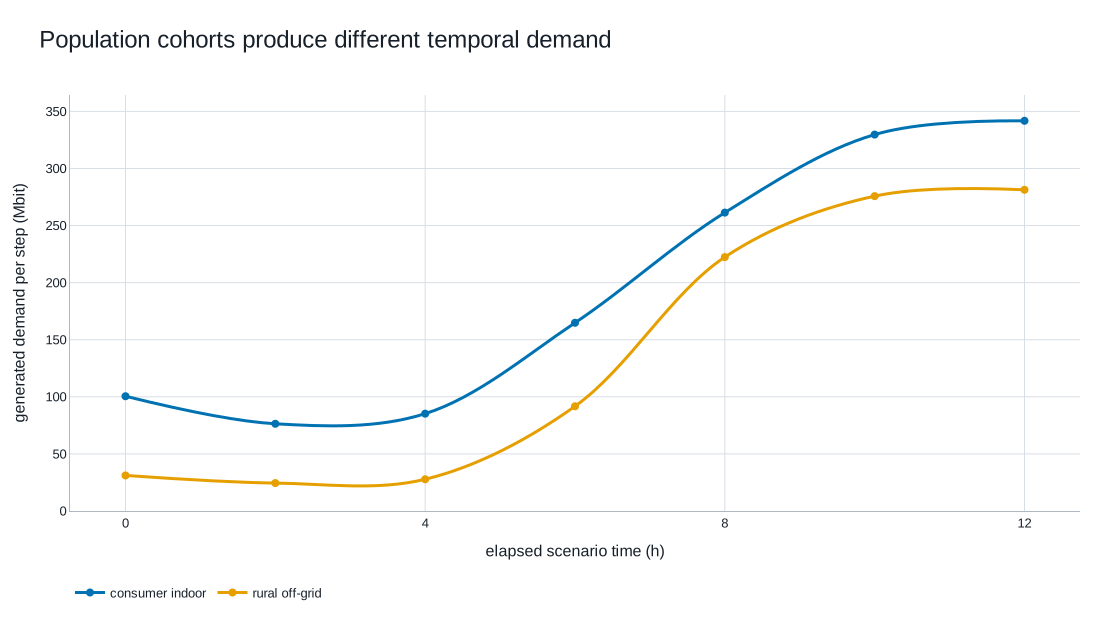
Population, terminal-cohort, and temporal assumptions define offered demand independently of available capacity.
scheduler_mode: none preserves physical and path opportunities without
resource-constrained admission. greedy_capacity performs deterministic
capacity-aware assignment. Use the former for bounded opportunity analysis and
the latter when interpreting served demand, denial causes, or backlog.
For joint allocation of bandwidth, downlink RF power and payload DC limits, see Demand-Driven Payload Resource Scheduling.
Beams And Targeting
Payload and feeder antennas can use fixed or steerable beams. A beam definition can provide its cone angle, peak gain, roll-off, mounting/orientation, and maximum steer angle. Generated layouts create repeatable beam sets; targeting policies can refresh steering targets from configured geography or demand.
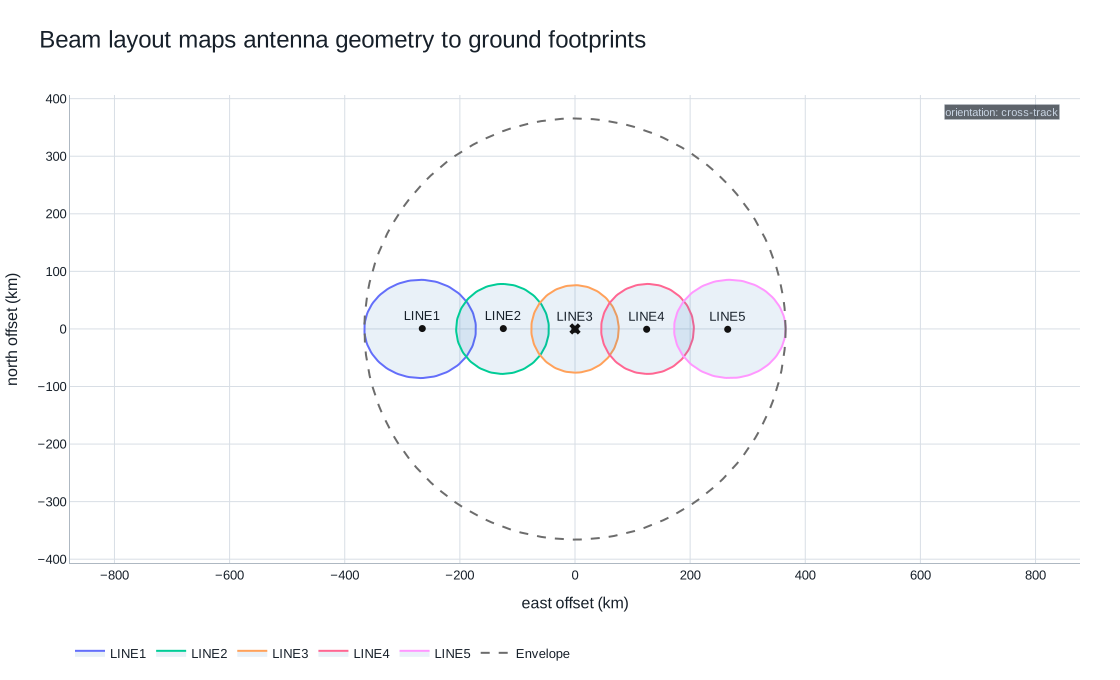
Beam cone, boresight offsets, layout, and steering limits define the eligible payload-link footprint.
The packaged steered-multibeam.yaml example uses eight demand-weighted beams
over two service regions and refreshes its target plan every ten minutes. For
time-slotted beam allocation, continuity, and co-channel constraints, see
Protocol-Informed Beam Hopping.
Path Modes
transport.scheduler.path_mode |
Meaning |
|---|---|
direct_plus_gateway |
Allows a direct service leg and reports gateway context when available. |
gateway_required |
Requires a closing user-to-satellite and satellite-to-gateway chain in the same opportunity. |
store_and_forward_gateway |
Allows traffic to wait for a later gateway opportunity within the configured horizon. |
isl_gateway_routed |
Allows a multi-hop satellite route to a satellite with gateway access. |
gateway_selection currently selects the lowest-latency visible gateway.
Store-and-forward and ISL modes add waiting or routing semantics; they should
not be compared directly with same-step gateway delivery without accounting for
their different latency and backlog behavior.
See Inter-Satellite Links for topology, terminal concurrency, and multi-hop constraints.
Outputs And Interpretation
The exact table set depends on artifact detail and enabled features. The main families are:
| Artifact family | Contents |
|---|---|
mission/service_summary.json and mission/service_* |
offered/served service, spatial and regional mission KPIs |
transport/transport_summary.json |
resolved mode, delivery, backlog, margin, phase timing, and run-level counts |
transport/transport_items.* |
generic traffic or product items presented to transport |
transport/transport_delivery_events.* |
delivered items, routes, volumes, and timestamps |
transport/transport_backlog_timeline.* |
queued volume over time |
transport/link_summary_points.* |
point-level closure and link-margin rollups |
transport/latency_summary_points.* |
point-level latency statistics |
transport/beam_assignments* |
selected beams and link legs |
transport/kpi_scheduler_global.json |
fleet-level scheduler totals and denial reasons |
transport/kpi_scheduler_by_point.* |
geographic attribution of scheduling outcomes |
Observation missions use the same transport machinery for captured data products, while observation usefulness and revisit remain mission-owned. See Mission Types for that distinction.
Scheduler denials identify the limiting resource rather than reporting every upstream consequence:
| Reason family | Interpretation |
|---|---|
no_closed_candidate |
no path passed the required physical and path gates |
uplink_* / downlink_* |
user-link slot or throughput limit |
feeder_* |
satellite-to-ground feeder slot or throughput limit |
beam_* |
active-beam or per-beam flow limit |
isl_* |
routed path blocked by ISL capacity, terminals, or pointing policy |
An assignment receives one primary denial classification, so totals can be used without double-counting the same rejected flow.
Packaged Examples
| Study | Example |
|---|---|
| Gateway-required service and latency | astraeus-resources/examples/user/service-downlink.yaml |
| Population-derived demand | astraeus-resources/examples/user/population-service.yaml |
| Dynamic multibeam targeting | astraeus-resources/examples/user/steered-multibeam.yaml |
| Routed 72-satellite ISL network | astraeus-resources/examples/user/isl-routed-network.yaml |
| EFC-based beam hopping | astraeus-resources/examples/user/beam-hopping-capacity.yaml |
| Observation capture through delivery | astraeus-resources/examples/user/observation-to-delivery.yaml |
| Large service-network performance | astraeus-resources/examples/user/large-leo-service-network.yaml |
Fidelity And Scale Limits
- Results resolve deterministic engineering link, allocation, backlog, latency, and delivery behavior at the configured cadence and profile fidelity.
- RF accuracy depends on the provided antenna, terminal, atmospheric, rain, and implementation assumptions. Profiles must explicitly represent relevant environment and hardware effects.
- Scheduler resolution covers bounded deterministic assignment and resource constraints at the declared beam, flow, and satellite levels.
- Cadence limits the timing resolution of contacts, steering refreshes, assignments, and backlog events.
- Dense point, beam, link, or all-pairs surfaces can dominate runtime and output size. Use spatial narrowing, sparse topology, artifact detail, and the documented execution profile deliberately.
For exact fields, use the RunSpec reference.