Propulsion
The propulsion stage applies defined maneuver plans to the propagated state and tracks their orbital and propellant consequences. Use it when the burn plan is already known and the engineering question is:
- how did the trajectory change?
- how much delta-v and propellant were used?
- was the target orbit reached within tolerance?
- what electrical load did a finite spacecraft burn create?
Main Inputs
A RunSpec propulsion study combines:
massfor dry, payload, and propellant masspropulsion.enginesfor thrust, specific impulse, throttle, and durationpropulsion.maneuver_plansfor per-satellite burnspropulsion.targetsfor orbital closure and tolerancespropulsion.policyfor finite-burn integration and target-reach behavior
mass:
  default:
    dry_mass_kg: 190
    payload_mass_kg: 35
    propellant_mass_kg: 20

propulsion:
  policy:
    reach_eval_mode: allow_wait
    finite_burn_step_s: 1
  engines:
    - engine_id: ep-main
      thrust_n: 0.5
      isp_s: 1500
      throttle_min: 0.2
      throttle_max: 1.0
  maneuver_plans:
    - satellite_id: CUSTOMER-EP-P1-1
      finite_burns:
        - burn_id: orbit-trim
          start_utc: '2026-03-01T00:10:00+00:00'
          duration_s: 600
          actor: satellite
          engine_id: ep-main
          throttle: 0.75
          direction:
            mode: orbital_enum
            orbital_enum: prograde
Burn directions can be expressed in supported orbital directions or as an inertial TEME vector. Finite burns are integrated at the configured internal burn step; impulsive burns apply their velocity change at a sampled event time.
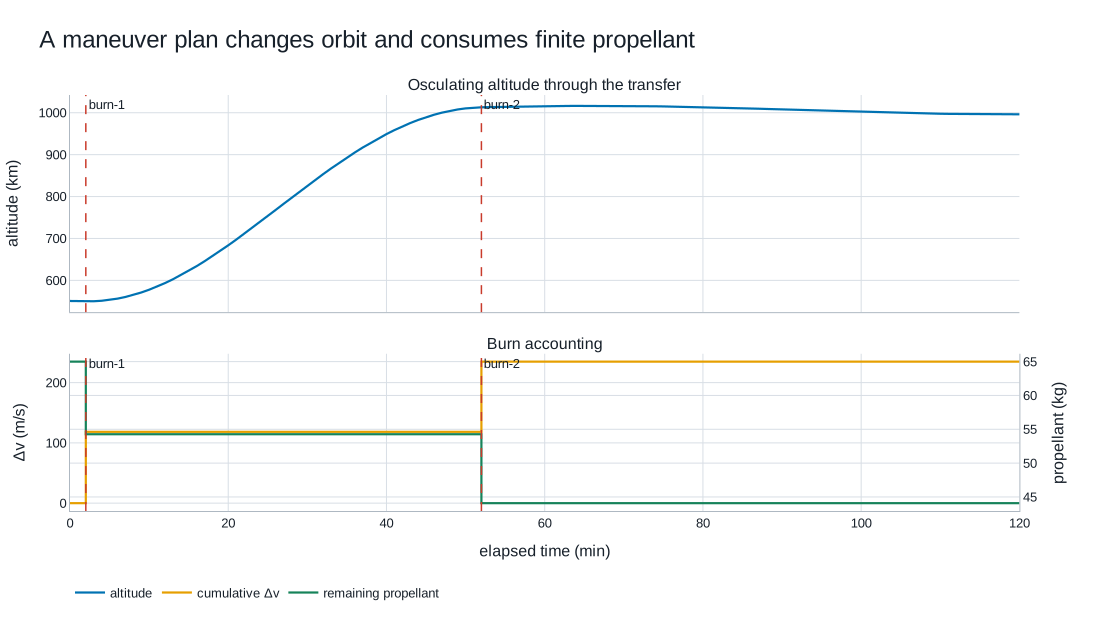
The transfer timeline ties maneuver events to orbital change, cumulative delta-v, and remaining propellant.
Power Coupling
For finite spacecraft burns, power.propulsion can map an engine to continuous
standby draw and an active increment. The active load may be constant or scale
with executed throttle. Partial simulation intervals are duty-weighted.
Spacecraft electrical load includes finite spacecraft-owned burns. Launcher- and
OTV-owned burns remain on their owning vehicle, while impulsive burns have no
finite electrical duration. Omitting power.propulsion preserves an uncoupled
power result.
Outputs
| Artifact | Contents |
|---|---|
propulsion/timeline_propulsion.parquet |
transfer state, accumulated delta-v, and propellant over time |
propulsion/burn_events.* |
requested and applied burn events and directions |
propulsion/transfer_summary_by_satellite.* |
transfer and resource summary per spacecraft |
propulsion/target_orbit_evaluation.* |
achieved orbit versus target and tolerances |
propulsion/propulsion_summary.json |
run-level settings, counts, and provenance |
These outputs are available to the Console analysis views and deterministic report/review workflows.
Packaged Example
Run:
astraeus run astraeus-resources/examples/user/propulsion-power-coupling.yaml
The example executes two finite electric-propulsion trims for one satellite and tracks the orbit, propellant, thruster load, battery response, and target-orbit evaluation in one result bundle.
Interpretation Limits
- The user-facing surface evaluates explicit RunSpec maneuver plans. Design optimization remains a separate workflow.
- Finite-burn fidelity depends on engine assumptions, mass inputs, direction,
and
finite_burn_step_s. - Target closure compares the propagated result against declared orbital tolerances. Navigation and flight certification require their own evidence.
- Thermal, structural, plume, detailed feed-system, and actuator-control effects require dedicated higher-fidelity models.
For exact fields, see the RunSpec reference.