Mission Types
mission.kind selects the intent modeled inside a RunSpec. Astraeus currently
supports two mission families:
servicefor communications availability and deliveryobservefor collection, product generation, and delivery
The mission stage creates domain truth. The shared transport stage then moves the resulting traffic or products through the configured network.
Choose The Mission Family
| Question | service |
observe |
|---|---|---|
| Primary intent | Serve user or demand locations | Collect target data |
| Geographic unit | Service points, grids, or regions | Target areas and target grids |
| Mission truth | Availability, offered demand, and service KPIs | Opportunities, captures, and data products |
| Transport work | Service traffic | Observation products |
| Typical outcomes | served fraction, capacity, latency, backlog | capture, delivery, timeliness, usefulness, revisit |
| Example baseline | service-downlink.yaml |
observation-to-delivery.yaml |
Choose service when the main question concerns users, demand, gateways,
capacity, scheduling, routing, or delivery. Choose observe when it concerns
target visibility, collection qualification, data products, delivery, or
revisit.
Service Missions
A service mission begins with geography and a communications profile:
mission:
  kind: service
  service:
    profile_id: nr_baseline
    ue:
      min_elevation_deg: 10
      min_access_s: 45
Typical supporting inputs define:
- service regions, grids, population, or terminal cohorts under
geographyandmission.service - ground gateways under
ground - link, beam, scheduling, routing, and ISL policy under
transport - reusable communications and component profiles through imports
Mission artifacts describe the service points and regional or directional KPIs. Transport artifacts then describe admitted and delivered traffic, capacity, latency, routes, and backlog. Use the Communications and service guide for model details and limitations.
Start with:
astraeus-resources/examples/user/service-downlink.yamlastraeus-resources/examples/user/population-service.yamlastraeus-resources/examples/user/isl-routed-network.yaml
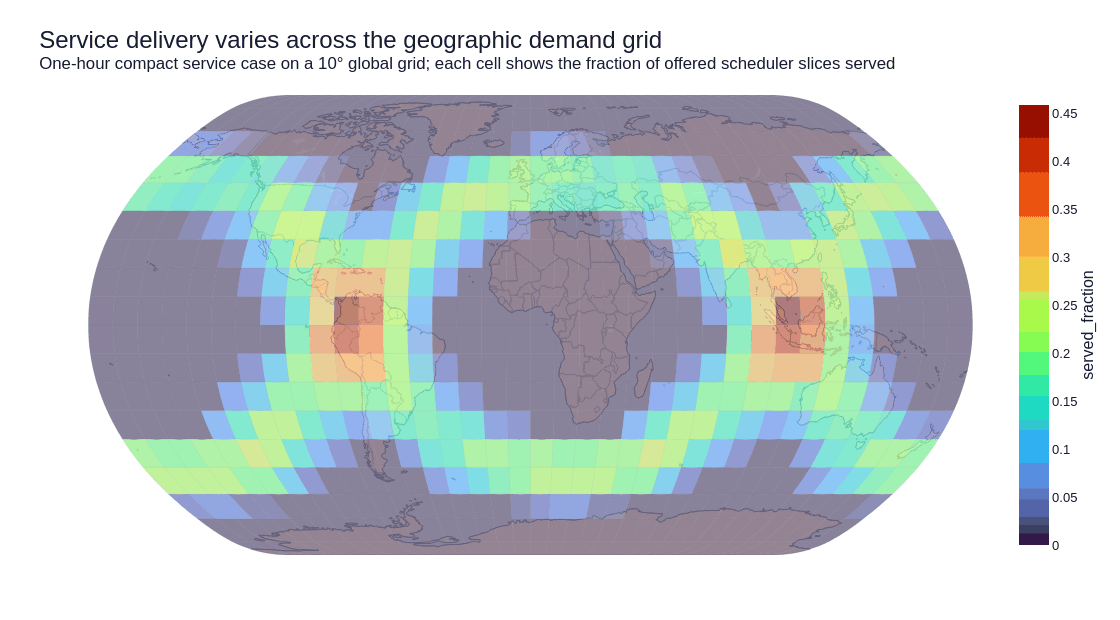
Spatial service summaries distinguish where demand was offered from where the selected access, gateway, and scheduling chain served it.
Observation Missions
An observation mission defines sensor behavior and targets:
mission:
  kind: observe
  observe:
    default_sensor_profile_id: regional_eo
    collection_pointing_mode: ground_track
    sensor_profiles:
      regional_eo:
        sensor_kind: generic_eo
        fov_half_angle_deg: 25
        max_off_nadir_deg: 35
        product_kind: observation_product
        product_size_bytes: 8000000
    targets:
      - target_id: target-region
        area_id: target-region
Typical supporting inputs define:
- target geometry under
geography - sensor field of view, off-nadir, dwell, and visible-fraction gates
- ground sites and transport policy for product delivery
- attitude and finite-slew realization when pointing feasibility matters
- activity and power coupling when capture, processing, or downlink loads matter
The mission produces opportunities, qualified captures, and data products. Transport reports whether and when those products reached their destination. Observation results can then summarize usefulness and revisit by target.
Start with:
astraeus-resources/examples/user/observation-to-delivery.yaml
The observation model supports first-order collection and delivery studies. Its resolution covers access, pointing realization, collection, and delivery rather than detailed sensor physics or collection optimization. See Attitude for pointing realization and its assumptions.
Shared Transport, Different Meaning
Service traffic and observation products use common connectivity, gateway, routing, scheduling, delivery, and backlog machinery. Similar transport files do not make the mission outcomes interchangeable:
- service asks how demand was served
- observation asks what was captured and delivered
- each mission family owns its own summary and KPI interpretation
Keep mission and transport stages together when end-to-end delivery matters.
Add attitude, power, or propulsion only when the engineering question requires
those couplings.
Service And Transport Result Terms
| Term | Meaning |
|---|---|
| Opportunity | A geometrically and operationally eligible chance to serve a point or move an item before resource allocation. |
| Offered demand | Traffic presented to the service and transport model. |
| Admission | Acceptance of offered traffic by the configured links, beams, scheduler, and capacity limits. |
| Service | The mission-level outcome for an eligible user or demand point. |
| Delivery | Traffic or a product reaching its configured destination. |
| Latency | Elapsed time across the modeled service or product-delivery path, including the configured waiting and processing terms. |
| Backlog | Admitted or generated data still waiting for delivery at a given time. |
| MO / MT | Mobile-originated and mobile-terminated traffic direction, viewed from the user terminal. |
Service, admission, and delivery answer different questions. A point can have a geometric opportunity while failing link closure, admission, or final delivery. Use the communications gate sequence to locate the limiting step.
Observation Result Terms
| Term | Meaning |
|---|---|
| Opportunity | A target encounter that passes the configured geometric and sensor eligibility gates. |
| Capture | An opportunity realized by the configured pointing, dwell, and collection rules. |
| Product | Data created by a capture and presented to transport. |
| Delivery | A product reaching its configured destination. |
| Revisit | Elapsed time between qualifying opportunities or captures for the same target, according to the selected result. |
| Timeliness | Time from capture or product creation to delivery. |
The observation funnel should balance explicitly: opportunities that do not become captures carry a rejection reason, while products that do not reach delivery remain attributable to transport state or the simulation horizon.
Run the curated baselines with:
astraeus run astraeus-resources/examples/user/service-downlink.yaml --run-id ex-service
astraeus run astraeus-resources/examples/user/observation-to-delivery.yaml --run-id ex-observe
For exact input fields, use the RunSpec reference.